Sleep Calculator – Find Your Ideal Bedtime & Wake Up Time
Sleep Calculator
Find your ideal bedtime or wake-up time based on 90‑minute sleep cycles
Your ideal sleep times will appear here
What is CalcSleepTimer
The CalcSleepTimer is a smart, science-based sleep cycle calculator and bedtime calculator that tells you when to sleep or wake up based on how your body naturally cycles through rest. Two ways to use it — plug in when you need to wake up and it shows ideal bedtimes, or enter when you’re going to bed and it calculates the best wake times. Students, professionals, shift workers, parents — doesn’t matter. This thing helps you finish complete 90-minute sleep cycles (the ones with deep sleep and REM included) so you actually wake up feeling human instead of half-dead. There’s also a sleep buffer you can adjust — defaults to 15 minutes, which is about how long most people take to drift off. Makes the timing way more realistic. Save the results, share them, copy them — whatever works.
Key Features of Our Sleep Calculator
This bedtime calculator is built around the standard 90-minute sleep cycle. Keeps you from waking up mid-deep-sleep.
Enter your desired wake time to get recommended bedtimes
Enter when you go to sleep to get recommended wake times
Range from 0 to 60 minutes
Default set on 15 minutes
Everything shows in AM/PM. No confusion.
Change the buffer or switch modes — results update instantly.
Copy, share, and save however you want.
How to Use the Sleep Calculator
Use this tool to calculate your bedtime or wake time in less than a minute. Results last way longer.
First — figure out which end you’re locked into. Wake time set in stone? Start there. Bedtime already decided? Use that. Type it in, then spend like 30 seconds being honest about how long you actually take to fall asleep. Most people stick with the 15-minute default, but if you’re someone who needs 25 or someone who’s out in 5, adjust it. That little tweak? That’s what separates a rough guess from something that actually works.
Calculator spits out multiple options — all built around full 90-minute cycles. Don’t just grab the first one. Pick whichever fits your actual day without forcing yourself into a corner. Then save it. Or screenshot it. Write it on your mirror if that helps. Knowing the window only matters if you use it.
Why Your Alarm Time Matters More Than Sleep Hours
I spent years thinking I just needed more sleep. Eight hours? Still felt like garbage. Nine? Same. That heavy, confused, can’t-think-straight feeling would hang around till lunch. Turns out timing beats duration. Six hours at the right moment beats nine hours at the wrong one. Your brain doesn’t rest in one smooth block — it cycles. And if your alarm rips you out halfway through deep sleep, doesn’t matter how long you were down. You’re wrecked.
Understanding Sleep Cycles: The Science Behind Better Sleep
What Actually Happens When You Sleep
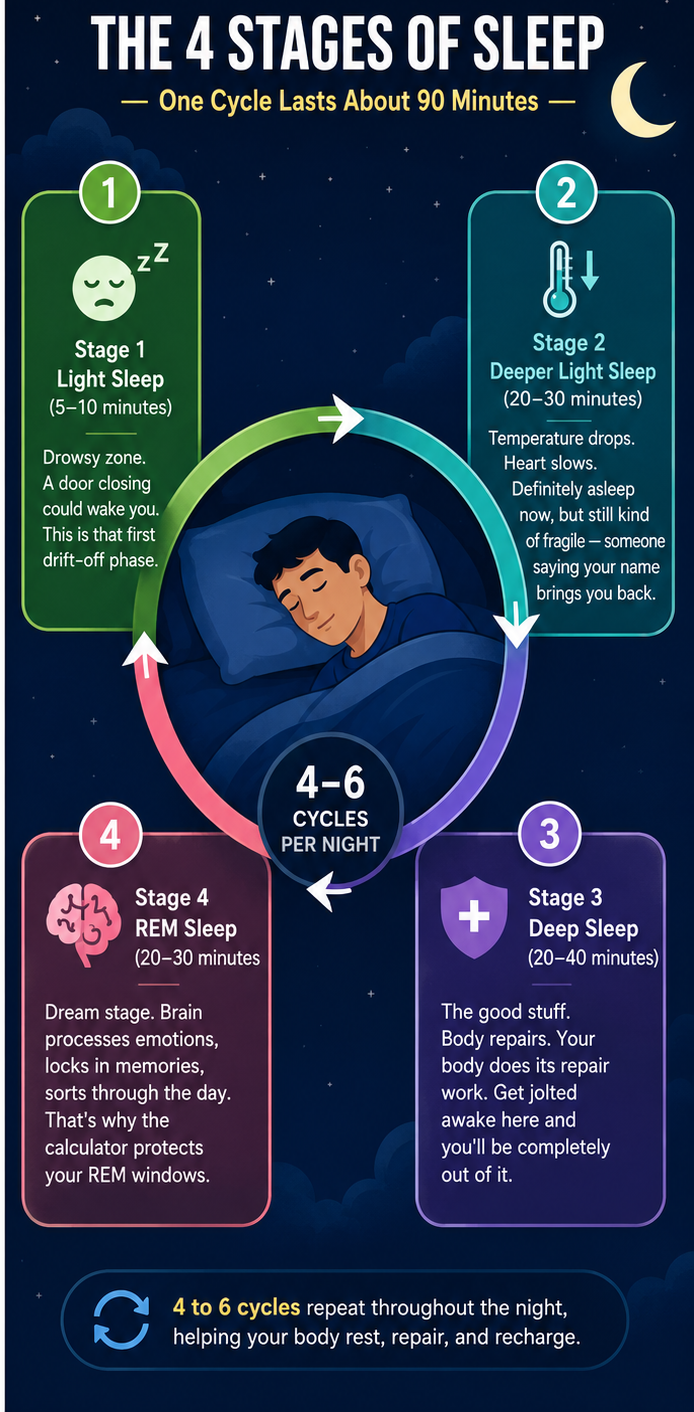
Your brain doesn’t flip off like a light switch. It runs through 4 sleep stages over about 90 minutes, loops back, does it again. Four to six rounds a night, usually.
Stage 1: Light Sleep (5–10 minutes)
Drowsy zone. A door closing could wake you. This is that first drift-off phase.
Stage 2: Deeper Light Sleep (20–30 minutes)
Temperature drops. Heart slows. Definitely asleep now, but still kind of fragile — someone saying your name brings you back.
Stage 3: Deep Sleep (20–40 minutes)
The good stuff. Body repairs. Your body does its repair work. Get jolted awake here and you’ll be completely out of it.
Stage 4: REM Sleep (20–30 minutes)
Dream stage. Brain processes emotions, locks in memories, sorts through the day. That’s why the calculator protects your REM windows.
The Critical Role of REM Sleep
Most people don’t know this: REM is where your brain actually cleans house. Sorts emotions. Files memories. Processes stress. Skip REM and you get snappy, forgetful, moody. Can’t think straight. People around you notice. Problem is, REM stacks up in those last couple hours before morning. Cut sleep short by even one hour? You’re not losing random minutes. You’re losing the REM chunk your brain desperately needs.
Three or four rough nights in a row and it’s obvious. Short fuse. Can’t remember things. Patience gone. Brain’s maintenance crew never showed.
Sleep calculator protects this by lining up your wake time with natural cycle breaks. REM stays whole. Brain gets what it needs.
What Is Sleep Inertia? (Why You Feel Groggy)
That awful, heavy, can’t-move feeling when your alarm goes off? It has a name: sleep inertia. What’s happening: your brain got dragged out of deep sleep mid-cycle. Like yanking the power cord on a laptop instead of shutting it down right. Brain’s trying to reboot — confused, sluggish, barely functional.
Some people shake it off in five minutes. Others carry it for an hour, maybe more. Morning’s shot. Irritable, can’t focus, need multiple coffees just to be semi-human.And here’s the kicker — total sleep hours don’t fix this. I’ve had nine-hour nights where I woke up destroyed. Six-hour nights where I felt great. Difference? Whether I surfaced between cycles or got ripped out mid-stage.
Sleep calculator dodges this. Does the timing work so you come up when your brain’s already light — alert, clear, ready.
How Much Sleep Do You Actually Need?
Depends on age. Genetics play a role too — some people genuinely run fine on seven hours, others need nine.
| Age Group | Hours Needed | Sleep Cycles |
| Adults (18-64) | 7-9 hours | 4.5-6 cycles |
| Older Adults (65+) | 7-8 hours | 4.5-5.5 cycles |
| Teens (14-17) | 8-10 hours | 5-7 cycles |
| Children (6-12) | 9-12 hours | 6-8 cycles |
Benefits of Using a Sleep Calculator
Wake Up Refreshed — No More Morning Fog
Not foggy. Not dragging. Not mainlining coffee. Actually awake.
Sharper Mental Focus Through the Day
When you’re not battling sleep inertia for half the morning, work clicks. Faster thinking. More creativity.
More Stable Energy Levels
That mid-afternoon crash? Smaller. The 3 PM wall? Easier to handle.
Consistent Sleep Routine Becomes Effortless
Once your sleep schedule locks in, sticking to it stops feeling like a fight.
Improved Overall Sleep Quality
Consistent cycle-based timing is the fastest way to improve sleep quality and the calculator makes that easier.
End the Sleep Guilt Cycle
No more “I’m just lazy” guilt trips. Turns out it was always about timing.
Honest Pros and Cons of Sleep Calculators
What Works:
- Waking between cycles is backed by actual science
- Energy difference shows up in a few days
- Adapts to any schedule
- Free, no setup
- Kills the bedtime guesswork
Where It Doesn’t Help:
- Won’t cure insomnia (see a doctor)
- Won’t fix sleep apnea
- Can’t solve stress-based sleep issues
- Works best with consistency
- Some people need way more than 15 minutes to fall asleep
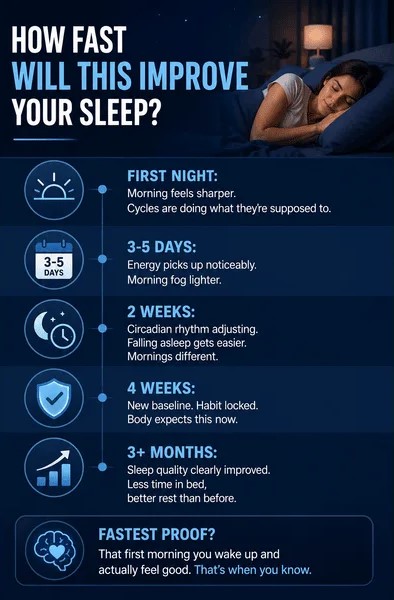
How Fast Will This Improve Your Sleep?
First night:
Morning feels sharper. Cycles are doing what they’re supposed to.
3-5 days:
Energy picks up noticeably. Morning fog lighter.
2 weeks:
Circadian rhythm adjusting. Falling asleep gets easier. Mornings different.
4 weeks:
New baseline. Habit locked. Body expects this now.
3+ months:
Sleep quality clearly improved. Less time in bed, better rest than before.
Expert Tips for Best Sleep Calculator Results
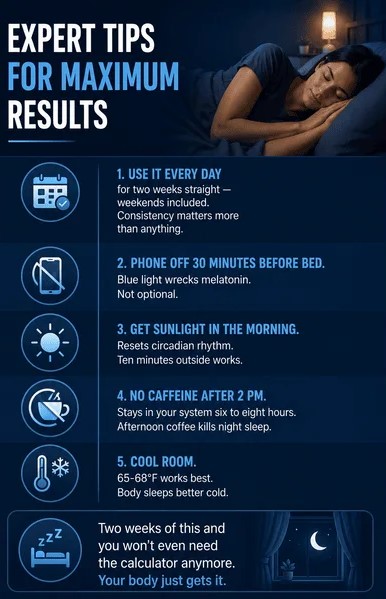
Use it every day for two weeks straight — weekends included. Consistency matters more than anything.
Phone off 30 minutes before bed. Blue light wrecks melatonin. Not optional.
Get sunlight in the morning. Resets circadian rhythm. Ten minutes outside works.
No caffeine after 2 PM. Stays in your system six to eight hours. Afternoon coffee kills night sleep.
Cool room. 65-68°F works best. Body sleeps better cold.
Two weeks of this and you won’t even need the calculator anymore. Your body just gets it.
The Science Behind This Sleep Calculator
Your body runs on a rhythm. Circadian rhythm, technically. Expects sleep at certain times, wakefulness at others.
Fight it? Feels terrible. Match it? Everything clicks. Calculator doesn’t create the rhythm — you already have one. Just helps you stop ignoring it. Which is why results come fast. Nothing’s being forced. Just lining up with what your brain’s already trying to do.
When Sleep Gets Messy: Real-Life Scenarios
Not every night goes perfectly. Late nights happen. Babies cry. One more episode turns into three. Panic hits around 1 AM usually: if I crash now, when do I even wake up?
That’s where this thing saves you. No groggy mental math. Just punch in “sleeping now” and get your best wake options. Maybe 5:30 works. Maybe 7’s better. Both let you surface between cycles instead of torpedoing your whole day. Turns panic into a plan.
Frequently Asked Questions – Sleep Calculator
Start Your Better Sleep Journey Tonight
Sleep looks simple until you try fixing it. Then the science shows up. Not magic. Not even complicated. Just math based on how your brain actually works. Try it tonight. Set your alarm to the calculated time. See what waking up refreshed actually feels like.
Sources & References
Sources:
- Sleep Foundation — Stages of Sleep — sleepfoundation.org/stages-of-sleep
- Carskadon MA, Dement WC (1980) — “Distribution of REM Sleep on a 90-Minute Sleep-Wake Schedule” — Oxford Academic / SLEEP Journal — academic.oup.com
- JAMA Psychiatry — “The 90-Minute Sleep-Dream Cycle” — jamanetwork.com
- NIH / PMC — “Process O: Cause of the 90-min sleep cycle” — pmc.ncbi.nlm.nih.gov
Disclaimer:
The CalcSleepTimer is intended for general wellness purposes only and does not constitute medical advice. Sleep duration recommendations are general guidelines and may vary by individual. If you experience chronic sleep issues, insomnia, or any sleep-related health concerns, please consult a qualified healthcare professional.